
Eurosurveillance banner


Eurosurveillance invites authors to submit papers for a special issue on HIV/AIDS and other sexually transmitted infections (STI) in men who have sex with men (MSM). The topic is in line with the main theme of World AIDS Day 2009 events organised by the European Centre for Disease Prevention and Control and aims at drawing attention to the epidemiological importance of MSM in HIV and other STI and directing the ECDC activities to focus on main risk groups.

Eurosurveillance is planning to publish a special issue on Socio-economic determinants and infections diseases in Europe in spring 2010. For this reason Eurosurveillance invites interested scientists who have research findings in the area to submit papers for review and possible publication. The submission deadline now is 15 November.

The data from 27 European Union countries plus Iceland, Liechtenstein and Norway show that considerable progress has been made in preventing and controlling the disease. The number of newly diagnosed cases and the overall notification rate declined continuously in the past decade, and the notification rate in 2007 was 12% lower than in 2003. In spite of this decline, a total of 84,917 new cases of TB were registered in 2007 and a number of challenges hamper the progress towards the elimination of TB in the EU.

A number of bacterial and viral infections in pregnant women can have serious effects on the unborn child leading to impaired mental and physical health later in life. This week’s issue of Eurosurveillance is dedicated to infectious diseases in pregnancy.

The emergence and spread of antimicrobial resistance (AMR) is a growing problem in many European countries. To mark the very first European Antibiotic Awareness Day, on 18 November, the scientific journal Eurosurveillance runs a series of articles to highlight main aspects of the AMR problem in Europe. They will be published in two issues on 13 and 20 November 2008.

In preparation for the coming influenza season 2008-9, Eurosurveillance publishes a special issue on prevention of influenza by vaccination. Seasonal influenza poses a serious public health threat because of associated serious morbidity and mortality. In Europe, estimates suggest that influenza is responsible for around 40,000 to 220,000 excess deaths, depending on the severity of the epidemic.

Today Eurosurveillance is publishing a special issue dedicated to the widespread advances made in Europe in estimating the real number of newly acquired HIV infections based on an innovative approach called STARHS

To tie in with World Hepatitis Day on 19 May, the scientific journal Eurosurveillance is today publishing a special issue on viral hepatitis, highlighting issues and challenges related to hepatitis B and C.

On 17 April 2008, Eurosurveillance is publishing a special issue with articles on the measles situation in Europe. The publication is linked to European Immunisation Week which runs from 21-27 April.

World Tuberculosis Day on 24 March commemorates the date in 1882 when Robert Koch presented his findings of the causing agent of tuberculosis (TB) – Mycobacterium tuberculosis. In the run up of this day Eurosurveillance publishes a special issue on the situation of TB in Europe.

Today (6 March, 2008), Eurosurveillance, the European peer-reviewed journal of infectious diseases, publishes a special issue on meningococcal disease. It includes two in-depth articles and an editorial by the European Centre for Disease Prevention and Control (ECDC).


In this issue


Home Eurosurveillance Edition  2009: Volume 14/ Issue 44 Article 10 Printer friendly version
Back to Table of Contents
Previous Download (pdf) Next

Eurosurveillance, Volume 14, Issue 44, 05 November 2009
Letters
Rhinoviruses, A(H1N1)v, RSV: The race for hivernal pandemics, France 2009-2010
  1. Hospices Civils de Lyon, National Influenza Centre, Laboratory of Virology, Lyon, France
  2. Université de Lyon, Department of Virology , Lyon, France

Citation style for this article: Casalegno JS, Bouscambert-Duchamp M, Morfin F, Lina B, Escuret V. Rhinoviruses, A(H1N1)v, RSV: The race for hivernal pandemics, France 2009-2010. Euro Surveill. 2009;14(44):pii=19390. Available online: http://www.eurosurveillance.org/ViewArticle.aspx?ArticleId=19390
Date of submission: 23 October 2009

To the editor: The A(H1N1)v circulation in France, like in other European countries (Sweden), is still reported as sporadic. The incidence of A(H1N1)v infections monitored in the community by the French National Influenza Centre has remained stable for 6 weeks from week 37 to week 42 (159 cases per 100,000 inhabitants). This is right above the epidemic cut-off of 114 cases per 100,000 inhabitants two months after the start of the new school year. This delay in the A(H1N1)v outbreak expansion is puzzling. At the same time, we report a high rhinovirus activity (34.5 % of samples positive for rhinovirus) in the community and in the hospital (unpublished data).

It has been postulated by A. Linde et al. [1] that the viral interaction between the A(H1N1)v and the rhinoviruses may explain partly this delay. This is an interesting hypothesis, indeed it is well known [2,3] that during winter, rhinovirus, respiratory syncytial virus (RSV) and influenza viruses epidemic peaks happen one after the other and occasionally overlap. The seasonal epidemiology of influenza is surely dependent on weather conditions such as low relative humidity and cold temperature [4]. These features were observed in our laboratory last winter.

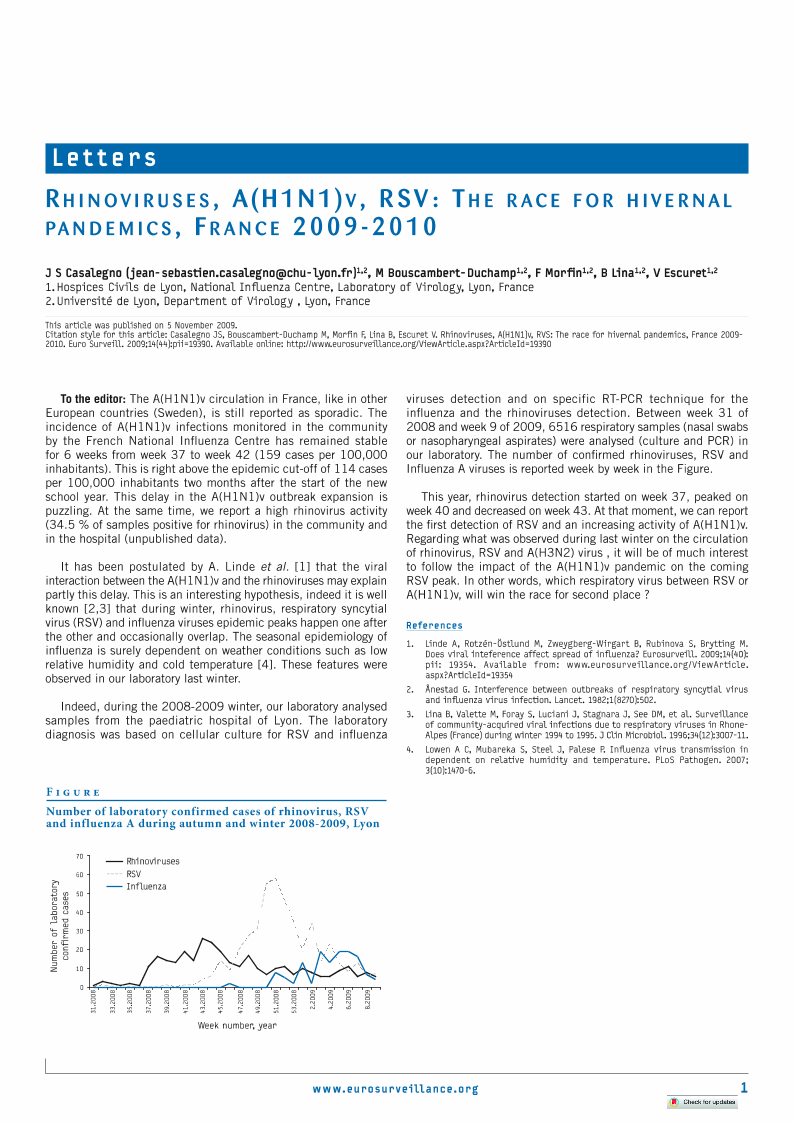
Indeed, during the 2008-2009 winter, our laboratory analysed samples from the paediatric hospital of Lyon. The laboratory diagnosis was based on cellular culture for RSV and influenza viruses detection and on specific RT-PCR technique for the influenza and the rhinoviruses detection. Between week 31 of 2008 and week 9 of 2009, 6516 respiratory samples (nasal swabs or nasopharyngeal aspirates) were analysed (culture and PCR) in our laboratory. The number of confirmed rhinoviruses, RSV and Influenza A viruses is reported week by week in the Figure.

Figure. Number of laboratory confirmed cases of rhinovirus, RSV and influenza A during autumn and winter 2008-2009, Lyon.


This year, rhinovirus detection started on week 37, peaked on week 40 and decreased on week 43. At that moment, we can report the first detection of RSV and an increasing activity of A(H1N1)v. Regarding what was observed during last winter on the circulation of rhinovirus, RSV and A(H3N2) virus , it will be of much interest to follow the impact of the A(H1N1)v pandemic on the coming RSV peak. In other words, which respiratory virus between RSV or A(H1N1)v, will win the race for second place ?


References


  1. Linde A, Rotzén-Östlund M, Zweygberg-Wirgart B, Rubinova S, Brytting M. Does viral inteference affect spread of influenza? Eurosurveill. 2009;14(40): pii: 19354. Available from: www.eurosurveillance.org/ViewArticle.aspx?ArticleId=19354
  2. Ånestad G. Interference between outbreaks of respiratory syncytial virus and influenza virus infection. Lancet. 1982;1(8270):502.
  3. Lina B, Valette M, Foray S, Luciani J, Stagnara J, See DM, et al. Surveillance of community-acquired viral infections due to respiratory viruses in Rhone-Alpes (France) during winter 1994 to 1995. J Clin Microbiol. 1996;34(12):3007-11.
  4. Lowen A C, Mubareka S, Steel J, Palese P. Influenza virus transmission in dependent on relative humidity and temperature. PLoS Pathogen. 2007; 3(10):1470-6.


Back to Table of Contents
Previous Download (pdf) Next

Disclaimer:The opinions expressed by authors contributing to Eurosurveillance do not necessarily reflect the opinions of the European Centre for Disease Prevention and Control (ECDC) or the Editorial team or the institutions with which the authors are affiliated. Neither the ECDC nor any person acting on behalf of the ECDC is responsible for the use which might be made of the information in this journal.
The information provided on the Eurosurveillance site is designed to support, not replace, the relationship that exists between a patient/site visitor and his/her physician. Our Website does not host any form of commercial advertisement.

Eurosurveillance [ISSN] - ©2008 All rights reserved
 

This website is certified by Health On the Net Foundation. Click to verify. This site complies with the HONcode standard for trustworthy health information:
verify here.