
Eurosurveillance, Volume
15, Issue
14,
08 April 2010
Association of D222G substitution in haemagglutinin of 2009 pandemic influenza A (H1N1) with severe disease
To the editor: The preferential binding of influenza virus to sialic acid-α2,3-galactose (α2,3 receptor) or sialic acid-α2,6-galactose (α2,6 receptors) may determine its tropism as α2,3 and α2,6 receptors are dominant on lower and upper respiratory cells respectively [1]. The recent glycan microarray analysis suggested that the haemagglutinin (HA) D222G substitution could cause a shift from α2,6 receptors to the mixed α2,3/α2,6 receptors specificity which might increase binding to α2,3 receptors [2] and contribute to severity of disease. This substitution in the HA gene has been reported in samples of viruses obtained from cases with mild to severe illness from around 20 countries, areas and territories [3]. A recent study from Norway has evaluated the clinical relevance of this substitution with severe and mild cases [4].
In an attempt to understand the relevance of HA D222G substitution among pandemic influenza A (H1N1) causing infections in Hong Kong, HA gene sequences from respiratory specimens and virus isolates of severe and non-severe cases were examined. Cases were individuals who had laboratory confirmed pandemic H1N1 influenza virus by either viral culture or reverse transcription PCR (RT-PCR) of respiratory specimens [5]. The severe cases were individuals classified by the attending physician as being in a serious or critical condition.
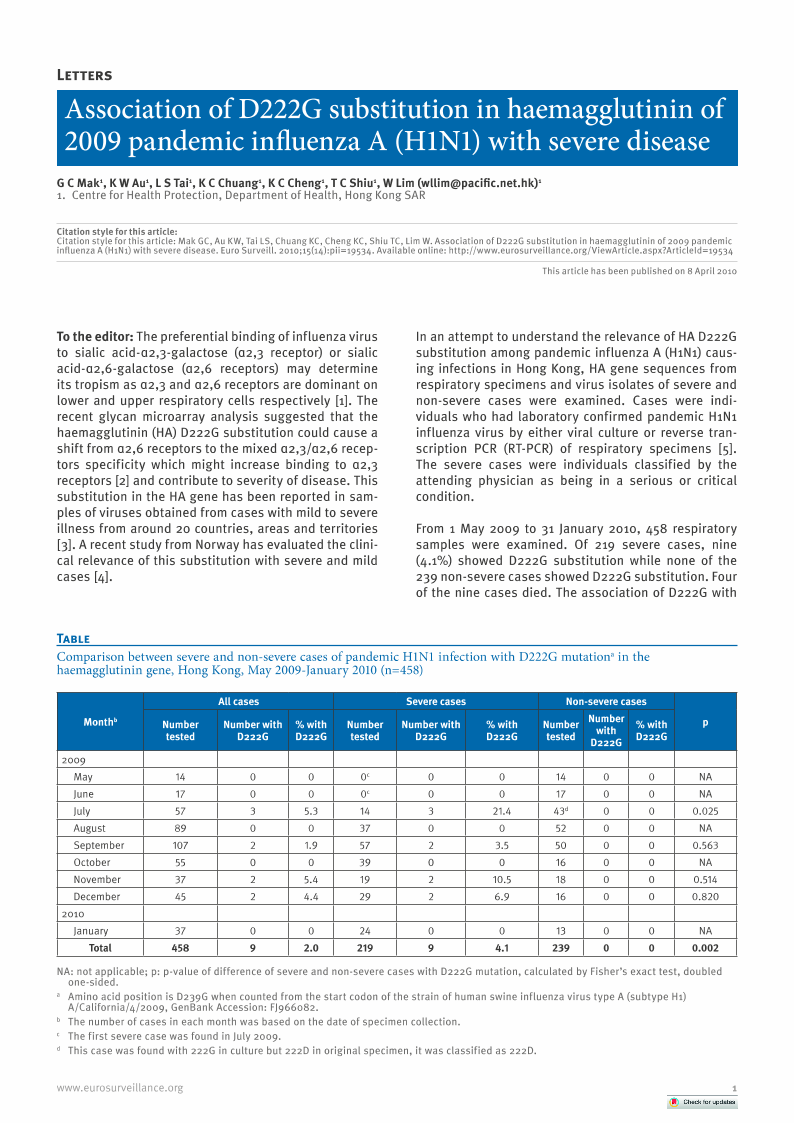
From 1 May 2009 to 31 January 2010, 458 respiratory samples were examined. Of 219 severe cases, nine (4.1%) showed D222G substitution while none of the 239 non-severe cases showed D222G substitution. Four of the nine cases died. The association of D222G with severe disease was statistically significant (p=0.002, Fisher’s exact test, doubled one-sided). Other substitutions, of D222N (severe cases, n=3; non-severe cases, n=1) and D222E (only in non-severe cases, n=4) were also found. The first severe case appeared on 6 July 2009 and D222G substitution was detected in July, September, November and December of the same year (Table).
Table. Comparison between severe and non-severe cases of pandemic H1N1 infection with D222G mutation in the haemagglutinin gene, Hong Kong, May 2009-January 2010 (n=458)

No distinct phylogenetic clusterings of the severe cases with D222G substitution have been observed (data not shown). To put this in perspective, from July 2009 to January 2010, the accumulated severe cases were 244 while the number of isolates in our laboratory was 25,625. Priority of analysis has been given to severe cases over non-severe cases, with 90% and 1 % of cases analysed respectively.
Influenza is an RNA virus which evolves rapidly, frequently changing surface structures. A recent study at the United States (US) Centers for Disease Control and Prevention reported 14 cases with D222G substitution found only in virus isolates but not in the original clinical specimens [3]. We observed similar finding with one non-severe case showing D222G substitution in a virus isolate but not in the original clinical specimen, however, for the other nine severe cases, we detected D222G substitution in both the virus isolate and original specimen. Similar to the Norwegian study, we also found mixed 222G and 222D in some severe cases [4]. Although experiments with ferrets did not support a causal link of D222G substitution with virulence [3], further study is warranted to elucidate the intriguing relationship between D222G substitution and severe disease.
References
- Shinya K, Ebina M, Yamada S, Ono M, Kasai N, Kawaoka Y. Avian flu: influenza virus receptors in the human airway. Nature. 2006;440(7083):435-6.
- Stevens J, Blixt O, Glaser L, Taubenberger JK, Palese P, Paulson JC, et al. Glycan microarray analysis of the hemagglutinins from modern and pandemic influenza viruses reveals different receptor specificities. J Mol Biol. 2006;355(5):1143-55.
- World Health Organization. Preliminary review of D222G amino acid substitution in the haemagglutinin of pandemic influenza A(H1N1) 2009 viruses. Wkly Epidemiol Rec. 2010;85(4):21-2 [English, French].
- Kilander A, Rykkvin R, Dudman S, Hungnes O. Observed association between the HA1 mutation D222G in the 2009 pandemic influenza A(H1N1) virus and severe clinical outcome, Norway 2009-2010. Euro Surveill. 2010;15(9) pii=19498. Available from: http://www.eurosurveillance.org/ViewArticle.aspx?ArticleId=19498
- Cheng PK, Wong KK, Mak GC, Wong AH, Ng AY, Chow SY, et al. Performance of laboratory diagnostics for the detection of influenza A(H1N1)v virus as correlated with the time after symptom onset and viral load. J Clin Virol. 2010;47(2):180-5.